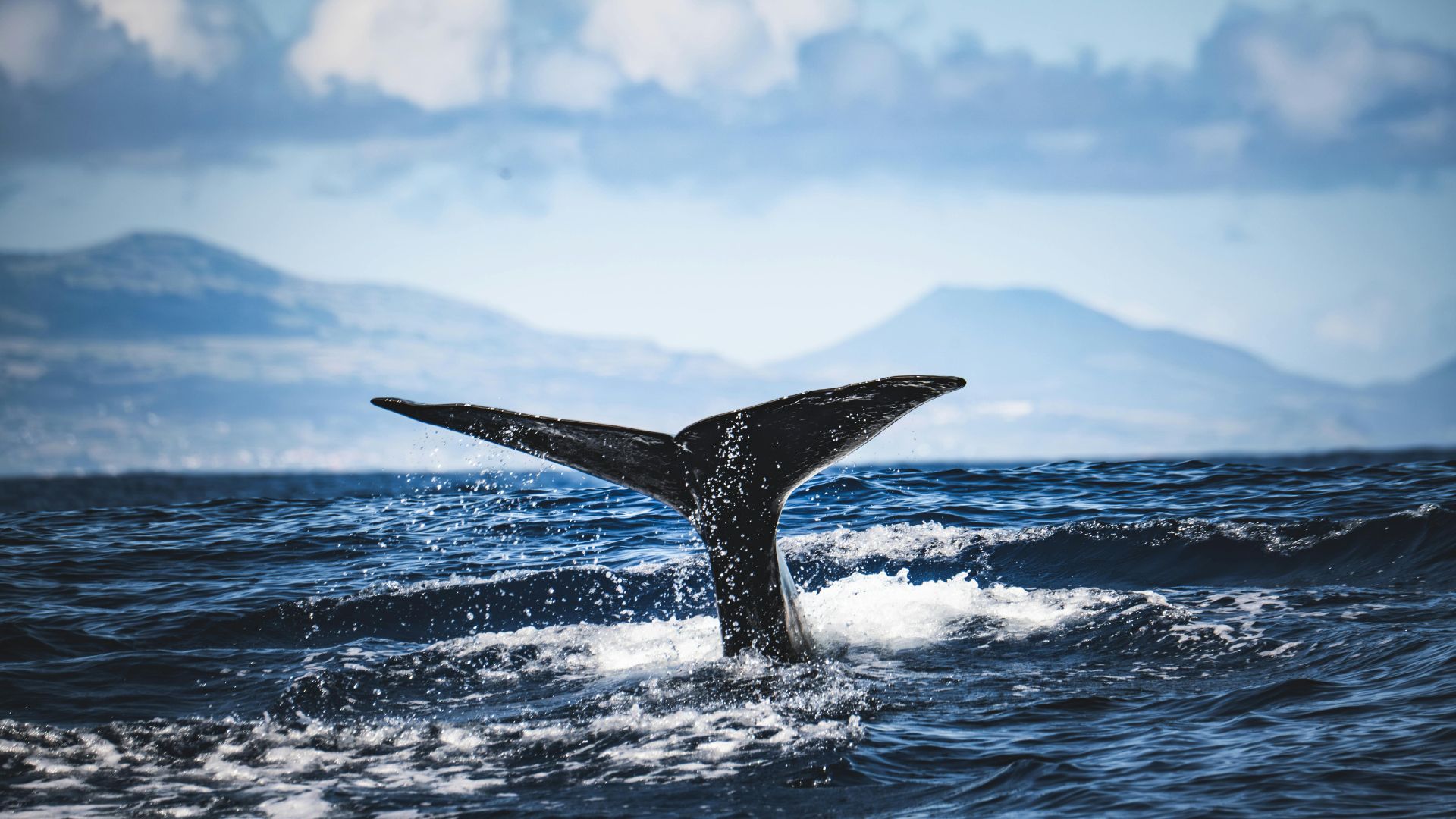
Whale songs fill the depths of every ocean on Earth. These complex, hauntingly beautiful compositions travel thousands of miles through the dark, but scientists have moved far beyond simply listening to them. They are now copying, analyzing, and mimicking these songs with a new purpose in mind: saving the ocean.
From using fin whale vocalizations as natural sonar instruments to deploying artificial intelligence that translates sperm whale click-codes, the field of marine bioacoustics is producing breakthroughs that most people have never heard of. Here is what science is doing with whale songs, and why it might be one of the most powerful conservation tools humanity has ever discovered.
The Hidden Language Beneath the Waves
Whale songs are far more sophisticated than most people realize. Humpback whales, for example, don’t just repeat the same tune year after year; they evolve their songs culturally, almost like human music trends. Research published in the Royal Society journal confirmed that humpback song “revolutions” spread progressively across ocean basins, with entire new song structures replacing old ones as they travel from one whale population to another. In 2025, a song phrase first recorded in Japan in 2024 was detected again in the waters off Maui, Hawaii, crossing the entire Pacific within a single year.

It doesn’t stop at humpbacks. Bowhead whales navigate through Arctic ice fields using complex moans and tonal signals, and males sing bi-phonated songs (layered signals produced on two frequencies simultaneously) during mating displays. Sperm whales use a Morse-code-like system of rhythmic clicks called codas, which females use to communicate in geographically distinct dialects. Each species has developed its own acoustic universe, and scientists are only beginning to map it.
How Scientists Copy Whale Song for Ocean Conservation
At the heart of modern ocean conservation is a technology called passive acoustic monitoring (PAM), which is, essentially, a network of underwater microphones called hydrophones that listen continuously without disturbing marine life. Unlike aerial surveys, which can only be conducted in daylight and good weather, PAM works around the clock in any conditions.
One of the most iconic tools in this field is the D-Tag, invented by researchers at the Woods Hole Oceanographic Institution (WHOI) in the late 1990s. It is attached to a whale’s back using suction cups, and records every sound the animal makes and hears, along with its depth, water temperature, and movement, creating a detailed travel log of its underwater life. After a few hours, the tag floats free, and scientists retrieve it to download the data.
The International Fund for Animal Welfare (IFAW) took this a step further by commissioning an entire research vessel dedicated to monitoring whale songs. The Song of the Whale sailed the US East Coast in 2023, deploying new hydrophone arrays to track critically endangered North Atlantic right whales. When a right whale call is detected, ships in the area are immediately alerted to slow down, which is a system that has directly reduced fatal vessel strikes against one of the world’s most endangered large mammals.
Project CETI: AI Is Now Translating Whale Song
Perhaps the most ambitious whale conservation project in history is Project CETI, the Cetacean Translation Initiative. Launched off the coast of Dominica in the Eastern Caribbean, CETI has assembled a team of over 50 experts in marine biology, artificial intelligence, linguistics, cryptography, robotics, and underwater acoustics.

Their goal is breathtaking in its ambition: to decode the language of sperm whales using machine learning. Using drones, on-whale sensors, and hydrophones, CETI records sperm whale codas, rhythmic click bursts produced when air is pushed through specialized structures in the whale’s head, and feeds the data into custom AI models designed to recognize linguistic patterns. Unlike standard large language models trained on human text, CETI’s models learn purely from acoustic data.
The results so far are remarkable. CETI has already identified between 100 and 600 distinct types of sperm whale codas, laying the groundwork for a potential whale “vocabulary”. A UC Berkeley study published in late 2025 found that sperm whales communicate in ways structurally similar to human language, with combinatorial elements that suggest meaning can be generated by combining different coda units. If CETI succeeds in full translation, it could fundamentally transform how humanity understands and legally protects whale species worldwide.
Fin Whale Songs Are Mapping the Ocean Floor
Here is a fact that rarely makes headlines: fin whale songs are so powerful and low-frequency that they penetrate the seafloor. A 2021 study published in Science confirmed that fin whale vocalizations at roughly 20 Hz can be used to map the density of ocean crust, functioning similarly to the seismic air-gun arrays that research ships fire to image the seafloor.
This discovery was extended further in a 2025 study published in Nature Scientific Reports, which found that fin whale songs can be detected by onshore seismometers up to 5.5 kilometers (3.42 miles) inland. Scientists detected fin whale songs in seismic recordings from Ireland, Iceland, Monaco, Mexico, and Antarctica, using equipment that was originally installed to measure earthquakes. What’s even more remarkable is that affordable citizen-science devices called “Raspberry Shake” seismometers, which cost a fraction of professional equipment, could reliably pick up fin whale songs.
This means that a global network of earthquake sensors is inadvertently functioning as a whale tracking system, and scientists are now leveraging that data for ocean conservation at no additional cost.
A 1949 Recording That’s Rewriting History
In early 2026, researchers at WHOI made a stunning archival discovery: the oldest known preserved whale song recording in the world, captured in 1949 aboard the research vessel R/V Atlantis near Bermuda. The recording of a humpback whale had been sitting on audograph discs in the WHOI archives for nearly 77 years and was only rediscovered during a digitization project.

This recording predates marine bioacoustician Roger Payne’s famous 1970 whale song discovery by nearly two decades. But what’s even more important is that it captures the ocean’s acoustic environment before the massive post-war expansion of global shipping traffic, providing scientists with a rare baseline of what whale communication sounded like in a quieter ocean. According to Peter Tyack, a marine bioacoustician at Woods Hole, comparing this historical recording with modern data will help scientists precisely measure how human-made noise has altered the way whales communicate over the past eight decades.
When Whales Go Silent, Oceans Send a Warning
One of the most alarming findings in recent research on whale songs is that whale vocalizations are declining, and this is due to climate change. A six-year study conducted off California’s coast revealed a 40% drop in blue whale vocalizations in the monitored region. This is because ocean warming is triggering marine heatwaves and collapsing krill populations, the tiny crustaceans that blue whales depend on for calories. Without enough energy, whales simply stop singing.
As Monterey Bay oceanographer John Ryan described it: “It’s like trying to sing while you’re starving.” This silence is a direct indicator of ecosystem collapse. When whales stop vocalizing, they stop navigating effectively, finding mates, and coordinating feeding. The silence of a whale is effectively the ocean’s distress signal.
Passive acoustic monitoring can detect these drops in vocal activity in near real-time, giving conservationists a living, breathing early-warning system for ocean health, which is something no satellite or temperature buoy can replicate.

The Future of Whale Song Ocean Conservation
The next frontier of whale song ocean conservation is speed and scale. Cornell University’s deep-learning model, which is trained to detect endangered North Atlantic right whale upcall vocalizations, now achieves 86% precision in automated detection, running continuously, day and night, across entire shipping corridors. This kind of always-on acoustic surveillance is replacing the old model of periodic aerial surveys and manual listening, which left enormous data gaps.
Simultaneously, the Songs of the Pacific Project (2023–2026) is coordinating 20 research partners across the Pacific Ocean, tracking how humpback whale songs evolve and migrate across thousands of miles of open water. Whale Trust, which is leading this initiative, plans to release the culmination of two multi-year studies on whale songs, health, and social behavior in 2026. This data could inform international marine protection agreements for decades.
What was once considered the passive background noise of the deep ocean is now one of science’s most powerful active tools. Whale songs are being used to map the seafloor, track endangered species, measure ecosystem health, and potentially, for the first time in history, open a two-way dialogue between humans and another intelligent species.
The ocean has always been speaking. But now, scientists are finally learning how to listen and copy what it says.
Articles You Might Like:
The Serengeti Would Collapse Without One Tiny, Unglamorous Insect
Endangered Species Success Stories: 9 Stories You Might Not Have Heard Of
Sources:
“UC Berkeley and Project CETI Study Shows Sperm Whales Communicate in Ways Similar to Humans.” University of California, Berkeley, 11 Nov. 2025.
“Fin Whale Song Recordings by Onshore Seismometers Open New Opportunities for Monitoring.” Nature Scientific Reports, 18 Apr. 2025.
“WHOI Discovers the Oldest Known Whale Recordings, Dating to 1949.” Woods Hole Oceanographic Institution, 10 Feb. 2026.
“New Study Advances Acoustic Monitoring of Endangered Whale.” Cornell University — Cornell Chronicle, 20 Feb. 2025.


Leave a Reply