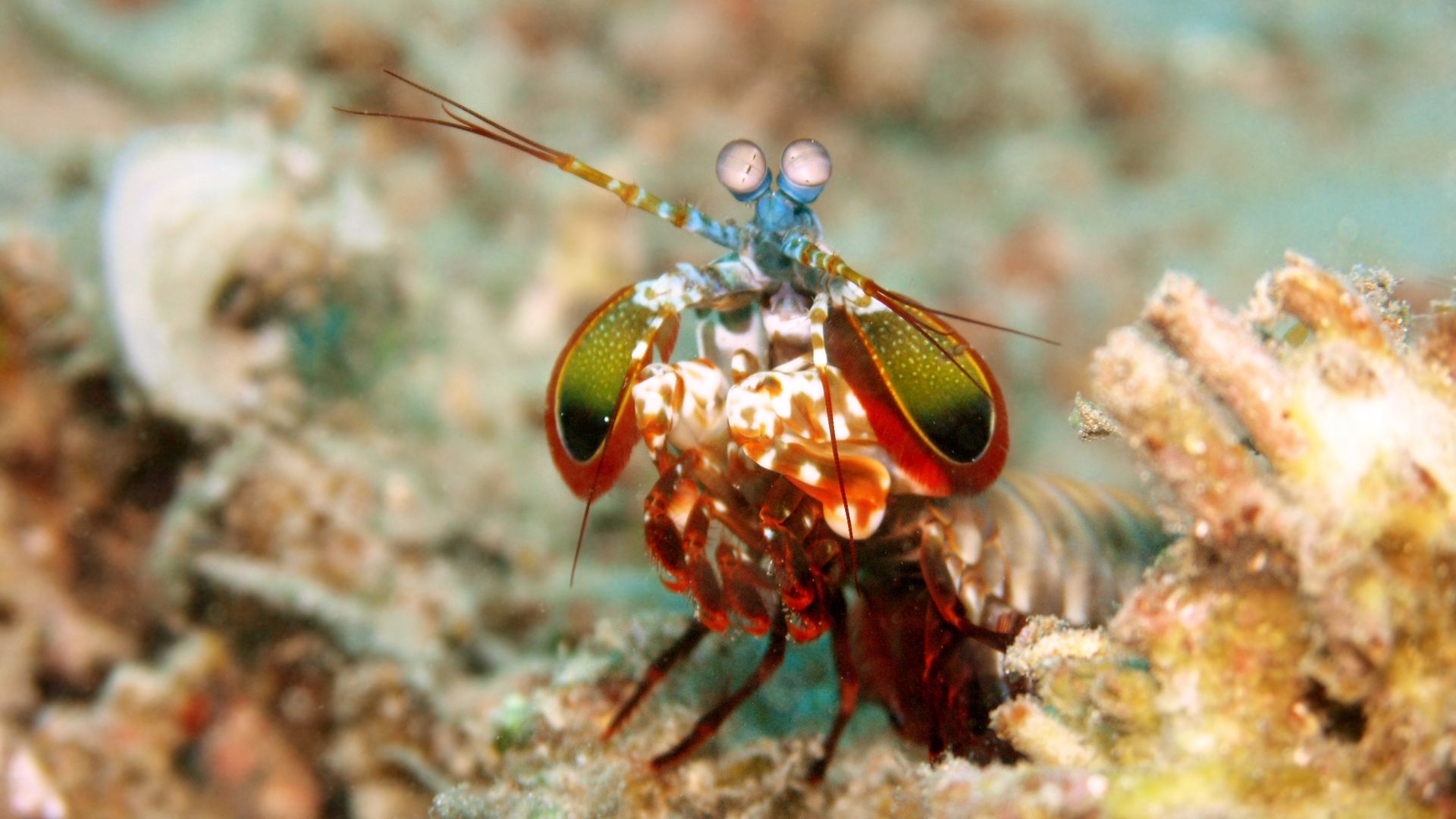
Somewhere in the shallow reefs of the Indo-Pacific, a creature the size of a banana is doing something that should be physically impossible. Several times a day, it throws a punch that briefly generates temperatures close to those found on the surface of the sun. No venom. No electricity. No chemical reaction. Just a fist.
The mantis shrimp holds a genuinely strange place in nature — it is the animal that punches stars into existence, and the same biology that makes it a devastating predator is now being used to detect cancer during surgery.
What Is the Animal That Punches Stars Into Existence?

Most people have never heard of a stomatopod. That is the actual order this animal belongs to — not shrimp, not mantis, but an entirely separate branch of crustacean life that split off from the main evolutionary line roughly 400 million years ago. The name “mantis shrimp” stuck because of a passing resemblance to both animals, but the comparison does not hold up to scrutiny.
There are more than 450 known species. Some are a muted, earthy brown. Others look like they were designed by someone who had never been told to show restraint. The peacock mantis shrimp (Odontodactylus scyllarus) falls firmly in the second category — a creature dressed in layered electric greens, burnt oranges, and deep reds that has no business looking this vivid while also being this dangerous.
That spectacular exterior conceals what many researchers consider the most extraordinary natural weapon ever documented.
The Punch That Cracks Aquarium Glass
The weapon itself is a pair of club-like appendages called dactyl clubs. When the mantis shrimp attacks, these clubs accelerate at over 10,000 times the force of gravity, hitting speeds of up to 23 meters per second — roughly 51 mph or 82 km/h. Some high-speed camera studies have recorded peak velocities closer to 31 meters per second (69 mph / 111 km/h).
That acceleration matches a 0.22 caliber bullet leaving the barrel of a gun. The resulting impact delivers around 1,500 newtons of force — enough to split open crab shells, shatter mollusk casings, and crack the reinforced glass of aquarium tanks. Aquarium staff who keep mantis shrimp in captivity often house them in thick acrylic rather than glass, and even then, they watch for fractures.
How the Animal That Punches Stars Into Existence Creates Stellar Heat

The peacock mantis shrimp cocks its dactyl club like the hammer of a gun, holding it under tension on a biological latch. When it releases, the stored elastic energy fires the club forward faster than the surrounding water can respond. This matters, because water that cannot move fast enough out of the way does something unexpected: it boils.
Not from heat — from pressure. The rapid movement drops the local pressure so sharply that the water vaporizes on the spot, forming small pockets of steam called cavitation bubbles. These bubbles exist for an extraordinarily brief moment before the surrounding water pressure crushes them back into nothing. That collapse is violent. Temperatures inside the imploding bubble approach 5,000°C — comparable to the surface of the sun — and the implosion releases a flash of bluish light that lasts for trillionths of a second.
This light-from-collapsing-bubbles phenomenon has a name: sonoluminescence. Physicists have studied it for decades and still cannot fully explain the mechanism behind it. What is clear is that every time a mantis shrimp throws a punch, it manufactures a tiny, short-lived star in the water around its fist. It does this dozens of times each day.
The Double Strike: Two Force Peaks for the Price of One
Speed tends to dominate the conversation around the mantis shrimp’s punch, but the research tells a more complicated story. Each strike actually produces two separate force peaks, spaced roughly 390 to 480 microseconds apart. The first comes from the physical impact of the club. The second — almost immediately after — comes from the cavitation bubbles collapsing against the target.
Peak limb impact forces range from 400 to 1,501 newtons. The cavitation forces that follow reach up to 504 newtons. That means prey absorbs two distinct shockwaves in under half a millisecond: the punch, then the implosion.
What makes this particularly sobering is that the second wave arrives even when the first misses. A mantis shrimp that strikes close enough to its target can stun or kill without making direct contact. The shockwave does the work.
The Saddle-Shaped Secret Behind the Animal That Punches Stars Into Existence
Muscle contraction alone cannot explain any of this. The speed the mantis shrimp achieves far exceeds what muscles are physically capable of producing — its strikes outperform muscle output by several orders of magnitude. The actual mechanism is closer to a crossbow than a fist.
The shrimp’s appendage contains a saddle-shaped structure that biologist Sheila Patek of Duke University has described as a hyperbolic paraboloid — a curved surface that stores elastic energy under compression without buckling. The shrimp loads this structure, holds it on a latch, and releases everything at once. The muscles set the trap; the stored energy fires it.
The club that delivers all of this force also never breaks. Over a lifetime of hunting, a mantis shrimp will throw thousands of these punches against hard-shelled prey, and the dactyl club shows no meaningful wear. The reason lies in its internal architecture: layers of chitin fibers wound in a helicoidal pattern, like a spiral staircase, that intercepts and disperses the destructive shear waves that would otherwise crack it from the inside out.
Inspiring the Next Generation of Bulletproof Materials

Engineers at the University of California, Riverside, and Purdue University have spent years trying to reverse-engineer that architecture. Their work uncovered a herringbone structure in the club’s outer layer — a pattern previously unrecorded anywhere in nature — that adds an additional layer of impact resistance on top of the helicoidal core. Together, these structures allow the club to transfer enormous force to a target while absorbing the rebound without fracturing.
The practical implications stretch well beyond marine biology. Ceramics are the material of choice for medical implants and military body armor, but they are brittle under repeated impact. Materials modeled on the mantis shrimp’s club architecture could change that, potentially making ceramics many times more durable. The same principles are being explored for football helmets, vehicle frames, seismic-resistant building materials, and protective gear across a range of industries.
All of this from an appendage belonging to a crustacean that measures around 10 centimeters — about 4 inches — from head to tail.
The Eyes of the Animal That Punches Stars Into Existence: 16 Colors vs. 3
The punch draws most of the attention, but the mantis shrimp’s eyes may end up having a larger impact on human life.
A human eye has three types of color receptors, tuned to red, green, and blue. The mantis shrimp has between 12 and 16, spread across stacked rows of photoreceptors that cover ultraviolet, visible, and near-infrared light, as well as the polarization of light — something human vision cannot detect at all.
“The mantis shrimp has these incredible eyes. Humans perceive three colors — red, green and blue — because of a single layer of light-sensitive cone cells that line our retina, but the mantis shrimp perceives upward of 12 colors thanks to stacked rows of photoreceptors, each tuned to different parts of the spectrum,” said Steven Blair, lead author of a landmark imaging study at the University of Illinois Urbana-Champaign.
The result is an eye that sees an enormous amount of information in a very small package — a combination that has proven almost impossible to replicate with conventional engineering.
How the Mantis Shrimp Is Saving Lives in the Operating Room
That visual complexity turned out to be exactly what cancer surgeons needed.
Researchers at the University of Illinois Urbana-Champaign developed a single-chip camera that captures ultraviolet, near-infrared, and visible light simultaneously, modeled directly on how the mantis shrimp eye separates different wavelengths across stacked photoreceptor rows. The goal was to give surgeons a way to see what their eyes cannot during cancer removal procedures.
The specific problem being addressed involves lymph nodes. When a patient undergoes breast cancer surgery, the surgeon must make judgment calls about which lymph nodes to remove. Take out too few, and cancer cells may remain. Take out too many, and the patient can develop lymphedema — chronic, often painful swelling that can persist for years. Until now, no tool available during an active operation could reliably show whether a specific lymph node was cancerous or clear.
The mantis shrimp-inspired camera pairs with tumor-targeted probes that bind to cancerous tissue and emit near-infrared light. The camera picks up that signal in real time, alongside normal visible-light imaging, giving the surgeon a live map of exactly where cancer is and is not present. The technology has moved beyond animal studies and is being tested in human surgical settings.
The Punch That Inspired Nuclear Fusion Research

The cavitation bubbles that form behind a mantis shrimp’s club reach temperatures between 5,000 and 10,000 Kelvin — and some estimates go considerably higher. For context, the surface of the sun sits at around 5,500°C. The inside of these collapsing bubbles, for a fraction of a microsecond, matches or exceeds that.
That fact has led some physicists to ask a serious question: could sonoluminescence be scaled up to trigger nuclear fusion? Fusion — the joining of atomic nuclei, which releases enormous energy — requires sustained extreme heat and pressure. Researchers have speculated that temperatures in sonoluminescing systems might reach millions of kelvins under the right conditions, which would put thermonuclear fusion within theoretical reach.
The scientific community remains divided on whether this is realistic. The temperatures involved are difficult to measure precisely, and replicating bubble collapse at a useful scale presents enormous engineering challenges. What is notable is that the question is being asked at all — and that it was a small reef crustacean that prompted it.
A Creature Out of Time
The mantis shrimp has been on Earth for around 400 million years. Flowering plants had not yet appeared when this animal’s ancestors were already punching. The dinosaurs came and went. Continental plates shifted. The mantis shrimp kept throwing star-temperature punches in warm shallow water and getting on with things.
Scientists are only now working out what it has quietly been doing all along. The same animal is simultaneously pointing the way toward stronger body armor, better building materials, more precise cancer surgery, and possibly a new approach to clean energy. It does none of this intentionally, of course. It is hunting snails.
The animal that punches stars into existence has been at it for longer than most things on this planet have existed. Humanity is, in the most literal sense, just catching up.
You Might Also Like:
The 12 Darkest Things Animals Do to Survive
Nature’s Unhinged: 8 Animal Discoveries That Sound Made Up (But Aren’t)
12 Tiny Animals With Terrifying Abilities
Sources:
Patek, S.N., and Caldwell, R.L. “Extreme Impact and Cavitation Forces of a Biological Hammer: Strike Forces of the Peacock Mantis Shrimp Odontodactylus scyllarus.” Journal of Experimental Biology, vol. 208, 2005, pp. 3655–3664.
Weaver, J.C., Milliron, G.W., Miserez, A., et al. “The Stomatopod Dactyl Club: A Formidable Damage-Tolerant Biological Hammer.” Science, vol. 336, no. 6086, 8 June 2012, pp. 1275–1280.
Yaraghi, N.A., Guarín-Zapata, N., Grunenfelder, L.K., et al. “A Sinusoidally Architected Helicoidal Biocomposite.” Advanced Materials, vol. 28, no. 32, 2016.
Blair, S., Liang, Z., Zhu, Z., et al. “Hexachromatic Bioinspired Camera for Image-Guided Cancer Surgery.” Science Translational Medicine, vol. 13, no. 594, 5 May 2021.
McNamara, W.B., Didenko, Y.T., and Suslick, K.S. “Sonoluminescence Temperatures During Multi-Bubble Cavitation.” Nature, vol. 401, 1999, pp. 772–775.
Lohse, D. “Sonoluminescence: Cavitation Hots Up.” Nature, vol. 434, 2005, pp. 33–34.


Leave a Reply