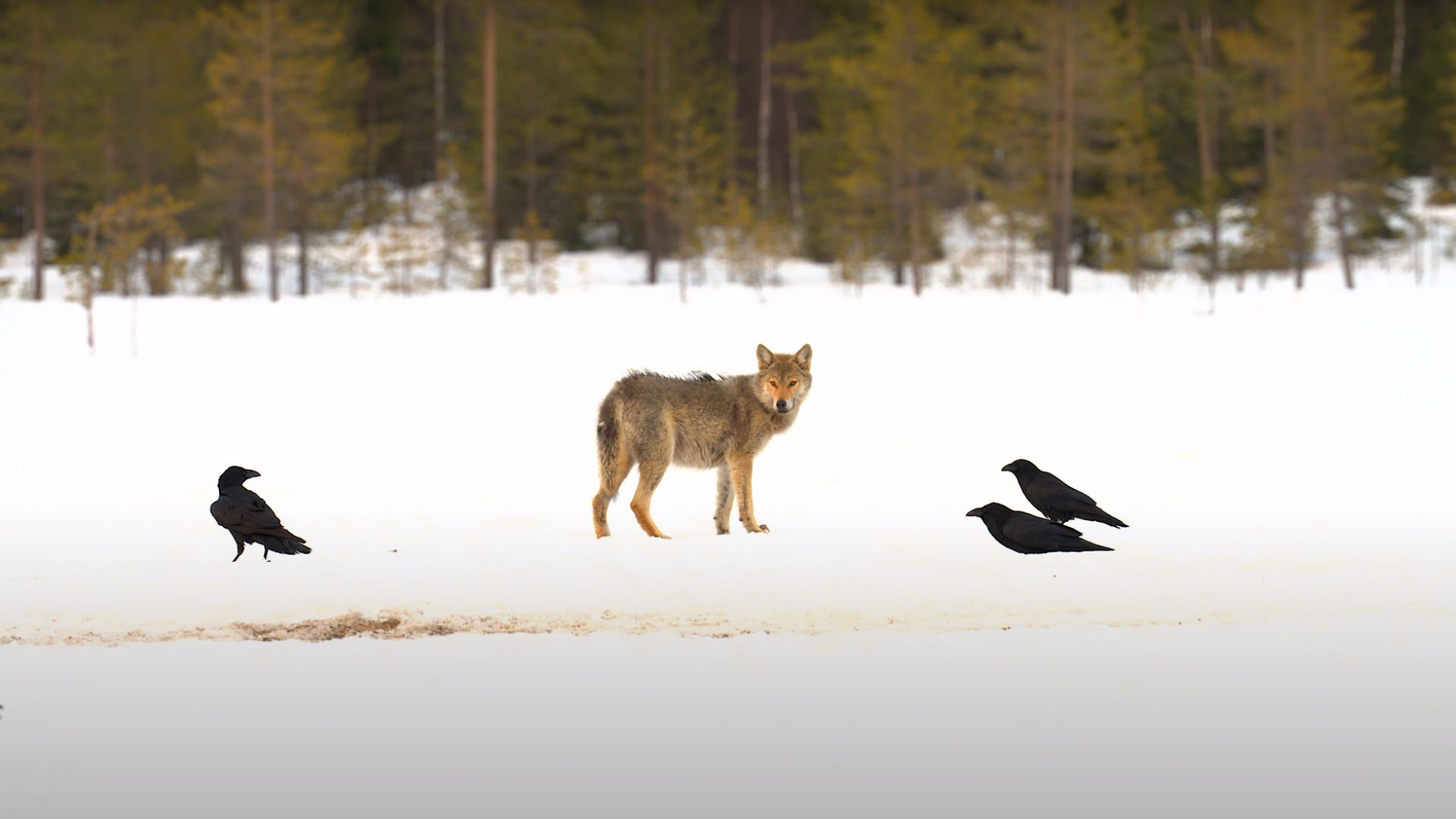
When a wolf pack brings down prey in Yellowstone National Park, the ravens arrive almost before the dust settles. Sometimes they’re circling before the wolves have even finished the hunt. For centuries, observers assumed the explanation was simple: the birds were following the wolves. Shadowing them. Hitching a ride on their violence. A landmark study published in the journal Science in March 2026 has found evidence that proves the contrary.
Ravens don’t follow wolves. They already know where the wolves are going to kill, and the mental faculties behind that knowledge is reshaping what scientists think animals are capable of.
The Study That Proved Ravens Don’t Follow Wolves

Researchers from the University of Veterinary Medicine Vienna and the Max Planck Institute of Animal Behavior, in collaboration with the Senckenberg Biodiversity and Climate Research Centre, the University of Washington, and Yellowstone National Park biologists, spent two and a half years tracking 69 ravens, 20 wolves, and 11 cougars across the wild terrain of Yellowstone and its surroundings in Montana, Wyoming, and Idaho.
Each bird was fitted with a small GPS transmitter, the kind that logs location and acceleration, much like a smartphone does. Each wolf already wore a collar, since Yellowstone’s wolf population has been monitored in extraordinary detail since the animals were reintroduced in 1995 after a 70-year absence. Hundreds of kill sites were catalogued. Thousands of hours of movement data were collected.
The numbers told a striking story. In 2.5 years of intensive tracking, researchers documented just one confirmed instance of a raven following a wolf for an extended period. One. Ravens still showed up at wolf kills with near-clockwork reliability, appearing at nearly half of all observed kills within just seven days. The movement data pointed to a completely different explanation than anyone expected.
Ravens Don’t Follow Wolves: They’ve Memorized the Territory
The birds were returning, again and again, to specific areas where kills had historically clustered. The behavior was anticipation, not reaction.
Lead author Dr. Matthias-Claudio Loretto of the University of Veterinary Medicine Vienna described the ravens’ behavior as relying on spatial memory and navigation to locate food spread across the landscape. The birds had built detailed mental maps of where death tends to happen, and they checked back regularly, independent of whether any wolf was in sight.
Some birds flew extraordinary distances to do it. Individual ravens were recorded covering more than 150 kilometers (93 miles) in a single day to reach a kill site, flying up to six hours non-stop in a straight line. Each flight was direct: no meandering, no circling, just a straight path to the site. That level of precision comes from a bird that knows, based on accumulated experience, that a particular ridge, river bend, or aspen corridor is worth checking.
What Ravens Were Really Doing Around Wolves

This finding doesn’t mean ravens avoid wolves. The relationship between them is stranger and richer than simple scavenging.
Ravens have long been documented mobbing wolves at kill sites, dive-bombing and harassing them to steal pieces of meat. They’ve also been observed doing something far more unexpected: playing with wolf pups. Biologists at Yellowstone have filmed young ravens and wolf pups engaged in what appears to be genuine play, chasing, rolling, and taking turns, a behavior with no obvious survival benefit for either party.
The new research clarifies that the relationship is not one of dependency. Ravens don’t need wolves to find food. Their memory works without them. When wolves are present, ravens exploit the situation. They carry their own navigation system, built from years of accumulated memory.
The same pattern held for cougars. Yellowstone’s mountain lions were tracked in the same study, and ravens used identical memory-based navigation to locate cougar kills, even though cougars are solitary, largely nocturnal, and far less observable than wolf packs.
Ravens Don’t Follow Wolves: The Norse Mythology Connection

The idea that ravens and wolves share a special bond is ancient. In Norse mythology, Odin kept two ravens, Huginn (Thought) and Muninn (Memory), who flew across the nine worlds each day and reported back what they had seen. He also kept two wolves, Geri and Freki, who accompanied him to battle. The ravens scouted; the wolves devoured. Together, they cleaned the fields of the dead.
For centuries, that myth was treated as a poetic exaggeration of something real but simple: birds follow predators. The mythology was, in a strange way, more accurate than the scientific consensus. The ravens in Yellowstone are operating on pure Memory, much like Huginn and Muninn themselves, building a cognitive map of the killing grounds and navigating it alone.
There is even a term in ecology for what scientists thought was happening: the “predator-tracking hypothesis,” which proposes that scavengers follow large carnivores to find food that would otherwise be too difficult to locate across vast, unpredictable terrain. That hypothesis, applied to ravens for decades, now needs serious revision.
Why Ravens Are Capable of Spatial Prediction

Ravens belong to the corvid family, alongside crows, jays, and jackdaws, a group that has repeatedly surprised researchers with cognitive abilities once considered uniquely primate.
Ravens have demonstrated the ability to plan for the future, saving tools and trading tokens for rewards they won’t receive until the next day. They’ve shown what scientists call “theory of mind,” an understanding that other individuals have their own perspectives and intentions, separate from their own. They deceive each other. They hold grudges. They have been documented consoling distressed flock-mates.
The Yellowstone study adds a new dimension to that established picture: this intelligence plays out across hundreds of square kilometers (square miles) of complex terrain, a scale researchers had never previously measured. The mental map a raven builds spans that entire range, annotated with probability data about where large predators tend to succeed.
“Ravens are already well-known for their intelligence,” said Dr. Loretto, “but seeing these cognitive abilities play out at a much larger scale in the wild produced startling results.”
What This Means for Conservation
The implications of this research extend beyond behavioral biology. If ravens are using historical kill zones as predictive landmarks, then the health of those kill zones matters enormously to raven populations, and to the broader scavenger communities that depend on large carnivore activity.
Yellowstone’s wolves were reintroduced in 1995, and their return triggered what ecologists call a “trophic cascade,” a chain reaction of ecological change that affected everything from elk populations to riverbank vegetation to beaver dams. Ravens were part of that cascade, quietly benefiting from the restored supply of carcasses. This research suggests they were adapting their cognitive maps in real time, updating spatial memory as wolf territory shifted and kill rates changed.
That has direct relevance to conservation decisions. Wildlife corridors, which allow predator populations to move between habitats, are typically designed around the movement needs of the predators themselves. This study suggests the intelligence of scavengers like ravens should also be factored in. Fragmenting wolf territory may degrade the accuracy of raven memory maps built up over years, effectively cutting off food access for birds that have never even been inside the protected zone.
The Bigger Picture: Rewriting What We Know About Animal Minds
The 2026 Yellowstone study is part of a growing body of research quietly dismantling assumptions about the cognitive line between humans and other animals. Bonobos have been documented engaging in pretend play. Dolphins have developed what researchers informally call a “WTF whistle,” a vocalization that appears to indicate confusion or disbelief. Wolves in Canada have been filmed retrieving submerged crab traps to access bait. Mice perform what looks remarkably like first aid on unconscious cage-mates.
In each case, the behavior was hiding in plain sight, observed but misinterpreted, assumed to be simpler than it was, until someone designed a study rigorous enough to reveal the truth.
Ravens predict wolves. They map the territory. They arrive before the hunt ends. For at least as long as Odin’s myths have circulated, humans have been watching this unfold and reading it backwards. The bird already knew.
You Might Also Like:
The Animals That Hold Funerals (And What Scientists Think It Means)
The 12 Darkest Things Animals Do to Survive
Nature’s Unhinged: 8 Animal Discoveries That Sound Made Up (But Aren’t)
Sources:
Loretto, Matthias-Claudio, Kristina B. Beck, Douglas W. Smith, Daniel R. Stahler, Lauren E. Walker, Martin Wikelski, Thomas Mueller, Kamran Safi and John M. Marzluff. “Ravens Anticipate Wolf Kill Sites Across Broad Scales.” Science, vol. 391, no. 6790, March 12, 2026, pp. 1151-1154.
Stahler, Daniel, Bernd Heinrich and Douglas Smith. “Common Ravens, Corvus Corax, Preferentially Associate With Grey Wolves, Canis Lupus, as a Foraging Strategy in Winter.” Animal Behaviour, vol. 64, no. 2, Aug. 2002, pp. 283-290.
Bugnyar, Thomas, Stephan A. Reber and Cameron Buckner. “Ravens Attribute Visual Access to Unseen Competitors.” Nature Communications, vol. 7, no. 10506, Feb. 2, 2016.
Kabadayi, Can and Mathias Osvath. “Ravens Parallel Great Apes in Flexible Planning for Tool-Use and Bartering.” Science, vol. 357, no. 6347, July 14, 2017, pp. 202-204.
Ripple, William J. and Robert L. Beschta. “Trophic Cascades in Yellowstone: The First 15 Years After Wolf Reintroduction.” Biological Conservation, vol. 145, no. 1, Jan. 2012, pp. 205-213.
Smith, Douglas W., Daniel R. Stahler and Erin E. Stahler. “Yellowstone Wolf Project Annual Report, 2023.” National Park Service, U.S. Department of the Interior, Yellowstone National Park, 2024.


Leave a Reply