From Sydney cockatoos operating drinking fountains to Tokyo crows reading traffic lights, the city is changing animals in ways science is only beginning to map.
Nobody told the wildlife they weren’t invited. They moved in anyway, figured out the trash cans, learned the traffic patterns, and in some cases started rewriting their own DNA. Cities were built for people, but animals have been quietly running their own experiments the whole time. The science catching up to all of it is genuinely surprising, and some of the recent findings are better than anything you’d see in a nature documentary.
Sydney Cockatoos Are Learning to Use Drinking Fountains. They’re Also Teaching Each Other How.
Here’s what sulfur-crested cockatoos in Sydney are doing at public drinking fountains: gripping the rubber spout with one foot, twisting the handle clockwise with the other, then pressing their body weight down to keep the water flowing while they drink. It’s a multi-step process that requires figuring out a piece of human equipment from scratch. Researchers clocked 525 attempts across the study period, and only 41% of them worked. The birds kept trying anyway.
The skill spreading through the population is where things get genuinely interesting. Researchers from the Max Planck Institute, the University of Vienna, Western Sydney University, and the Australian National University set up cameras and watched birds line up at the fountains at dawn and dusk, waiting their turn. One bird figured it out. Others watched. Then they did it too. Scientists are calling it a new cultural tradition, one the cockatoos invented themselves and passed around like a useful piece of information.
This is actually the second time Sydney’s cockatoos have pulled something like this. The first was the bin-opening trick, documented in a 2021 study, where birds learned to pry lids off household trash cans on collection night. That spread across dozens of suburbs. Residents started putting weights on the lids. The cockatoos adapted. The city is changing animals. These birds are keeping score.
Tokyo Crows Use Traffic Lights as Tools. They Also Know Not to Get Hit.

This behavior has been documented for decades, but recent analysis really nails how calculated it actually is. Carrion crows in Tokyo station perch on treetops and power lines next to pedestrian crosswalks. Light turns green, traffic moves, and they drop hard-shelled walnuts onto the road. The cars do the cracking. Then the light changes, the crosswalk opens, and the crows swoop down to collect.
They’ve turned cars into nutcrackers. And they understand the light sequence well enough to know when it’s safe to land. In a city of roughly 14 million people, Tokyo’s carrion crows have folded human traffic engineering into their daily routine like it was always there.
The behavior has since shown up in cities around the world, which tells researchers that crows aren’t learning it from each other across continents. They’re figuring it out independently, wherever hard-shelled food meets a traffic light. Scientists studying urban animal intelligence keep coming back to Tokyo’s crows as one of the best examples they’ve got.
Urban Raccoons Are Demonstrating Human-Like Problem-Solving Skills in Real Time

Anyone who has watched a raccoon methodically work through a locked trash can has probably had the feeling that something deliberate is going on. That feeling checks out. In a study published in Proceedings of the Royal Society B, researchers in Laramie, Wyoming, set up multi-compartment puzzle boxes baited with food and placed them around the city: behind a food store, in a residential backyard, near an abandoned barn. One in four raccoons cracked the puzzle. The hardest box had four completely different locking mechanisms.
The raccoons who had been hanging back and waiting for other animals to do the work, the ones the researchers called “scroungers,” ended up learning the easy solution first and then working their way up to the harder ones. “We believe this illustrates how learning begets learning,” the researchers noted.
One raccoon named Great Basin stood out. When a competitor got to the box first, Great Basin jumped on top of the cabinet and unlatched a door while hanging upside down. The broader takeaway: cities may be actively pushing certain animals to get smarter by surrounding them with problems worth solving.
Urban Foxes in Britain Are Getting Smarter, But Only After 40 Years in the City

Red foxes have been moving into British cities for decades, and new research turned up something that reframes a lot of it: how long a population has lived in a city matters a lot more than whether they live there at all.
A 2025 study placed puzzle-feeding boxes at 284 locations across Great Britain and compared rural fox populations, recently urbanized ones, and groups that had been city foxes for over 40 years. Foxes from 27.4% of locations touched the boxes. Foxes from 12.4% actually solved them. The long-established urban populations pulled ahead on both.
Moving to a city doesn’t flip a switch. The city has to work on a population across generations before real behavioral shifts show up. It selects for bolder animals, more curious ones, the ones willing to poke at something new. Britain’s urban fox, now a fixture from London to Glasgow, is the perfect test case for watching that process play out over time.
City Birds Have Physically Evolved Higher-Pitched Songs to Cut Through Traffic Noise
This is evolution happening right now, in city parks. Blackbirds, great tits, and rufous-collared sparrows all sing at measurably higher pitches in cities than in rural areas. The reason is simple: low-frequency traffic noise, the constant rumble of engines, drowns out lower-register birdsong. Birds that pitch higher get heard, attract mates, and raise offspring that do the same.
A large proportion of bird species learn their songs by imitating adults, in a process that’s pretty close to how humans pick up language. In cities, the songs that carry over the noise are louder and higher, so that’s what young birds copy. Do that across enough generations, and the vocal range of the whole population shifts.
The experiment that settled it for researchers involved raising urban juncos in quiet aviaries with no traffic noise, then comparing them to rural juncos raised in the same conditions. The urban birds still sang higher. The pitch wasn’t just learned anymore. It had been written into their biology. The city changed them at the source.
Urban Coyotes Are Rewriting Their Own DNA to Survive City Life

Coyotes are everywhere now. Los Angeles, Chicago, Toronto, New York. They’ve figured out city living at a behavioral level for a while, but a 2024 genetic study published in Genome Biology and Evolution found the adaptation goes much deeper. City coyotes are changing at the DNA level, and it’s happening fast, within just a few generations.
Researchers found specific mutations tied to metabolism that help urban coyotes handle the diet they’re actually eating: high-fat, processed, whatever people leave behind. Coyote researchers have taken to calling it the “cheeseburger diet.” Other gene changes help city coyotes tolerate the heavy metals in urban soil, the kind of contamination that hits rural coyotes much harder.
City coyotes are becoming biologically distinct from their rural relatives. And on top of the genetic changes, they’re bolder, more exploratory, and more willing to engage with new situations. In Chicago, researchers have tracked coyotes navigating multilane highways and pausing at curbs before crossing, behavior that looks a lot like learned road caution.
City Life Is Making Animals More Similar to Each Other. That’s a Problem.
There’s a darker thread running through all of this worth paying attention to. Scientists call it behavioral homogenization. As animals adapt to cities, species from completely different backgrounds, in completely different cities, start acting the same way.
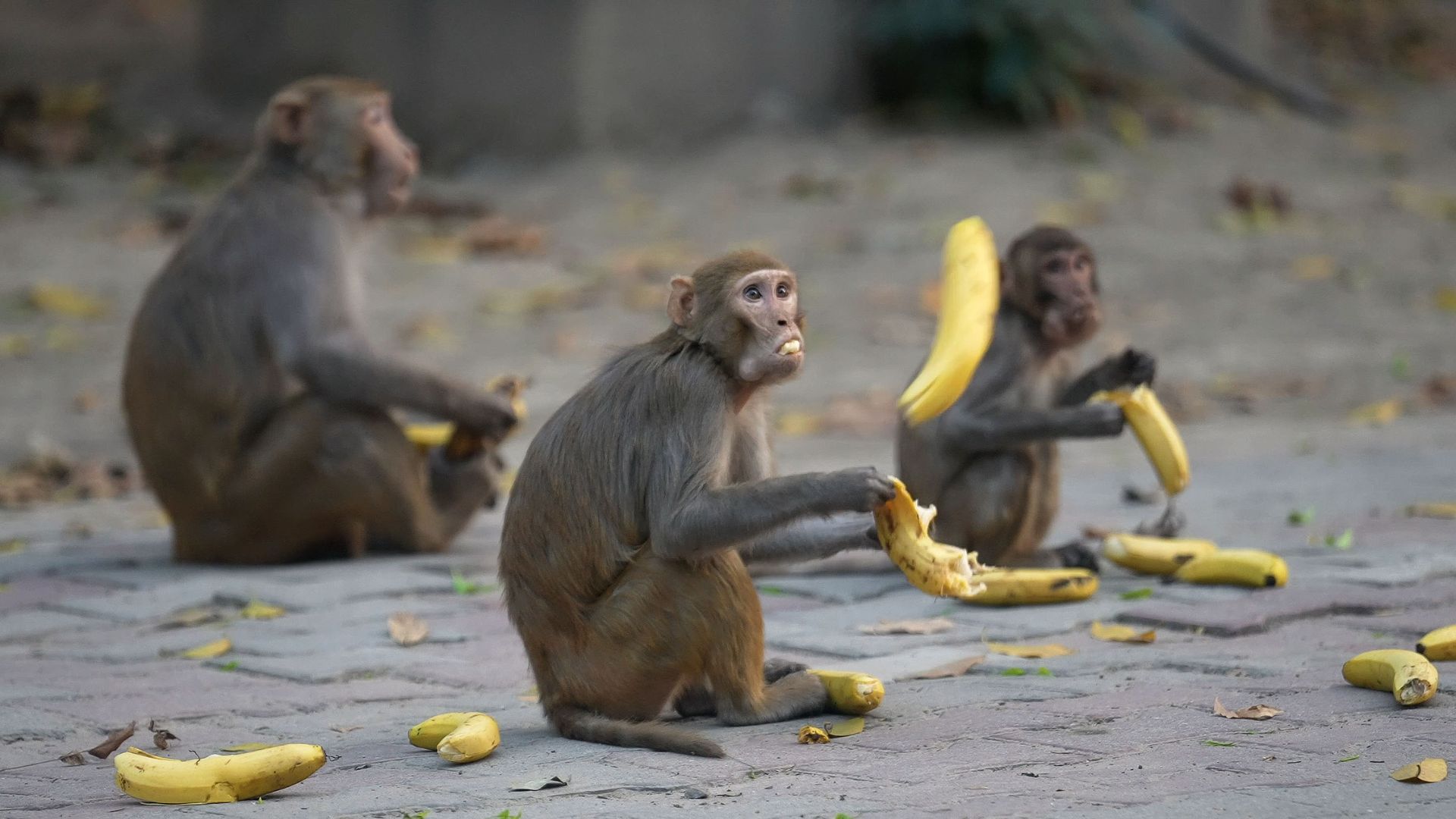
Monkeys in New Delhi, squirrels in New York, white ibises in Sydney (locals call them “bin chickens” for their habit of raiding trash cans and swiping lunches) are all landing on the same basic playbook: be bold, be opportunistic, eat whatever people leave behind. Rural animals spread their foraging across a wide range of places and foods. City animals cluster around garbage and end up on a diet that’s consistent but not great.
A 2025 review from Bielefeld University that pulled together studies across species and continents found that cities mess with animal social lives far more than researchers previously assumed. Constant noise, artificial light, and sealed surfaces all affect communication, group behavior, and aggression. Ninety-two percent of reviewed studies found notable effects.
The city is changing animals, but not always toward long-term resilience. Animals that get too dependent on human food and human environments may be losing the behavioral range they’d need if any of that shifted. Urban adaptation carries a cost. It just doesn’t always show up on the bill right away.
Sources:
Klump, Barbara C., et al. “Emergence of a Novel Drinking Innovation in an Urban Population of Sulphur-Crested Cockatoos, Cacatua galerita.” Biology Letters, The Royal Society, 1 June 2025.
Stanton, Lauren A., et al. “Wild Raccoons Demonstrate Flexibility and Individuality in Innovative Problem-Solving.” Proceedings of the Royal Society B: Biological Sciences, 24 July 2024.
Morton, Blake, et al. “Time in the City: Long-Term Urban Exposure Predicts Greater Exploration and Problem-Solving in Wild Red Foxes.” bioRxiv, University of Hull, 2025.
Kreling, Samantha E.S., Summer Vance, and Elizabeth Carlen. “Adaptation in the Alleyways: Candidate Genes Under Potential Selection in Urban Coyotes.” Genome Biology and Evolution, Oxford University Press, 30 Dec. 2024.
Slabbekoorn, Hans, and Margriet Peet. “Birds Sing at a Higher Pitch in Urban Noise.” Nature, vol. 424, no. 6946, 17 July 2003, p. 267.
Maune, Avery L., Barbara A. Caspers, and Isabel Damas-Moreira. “The Impact of Urbanisation on Social Behaviour: A Comprehensive Review.” Biological Reviews, Bielefeld University, 29 Dec. 2025.


Leave a Reply