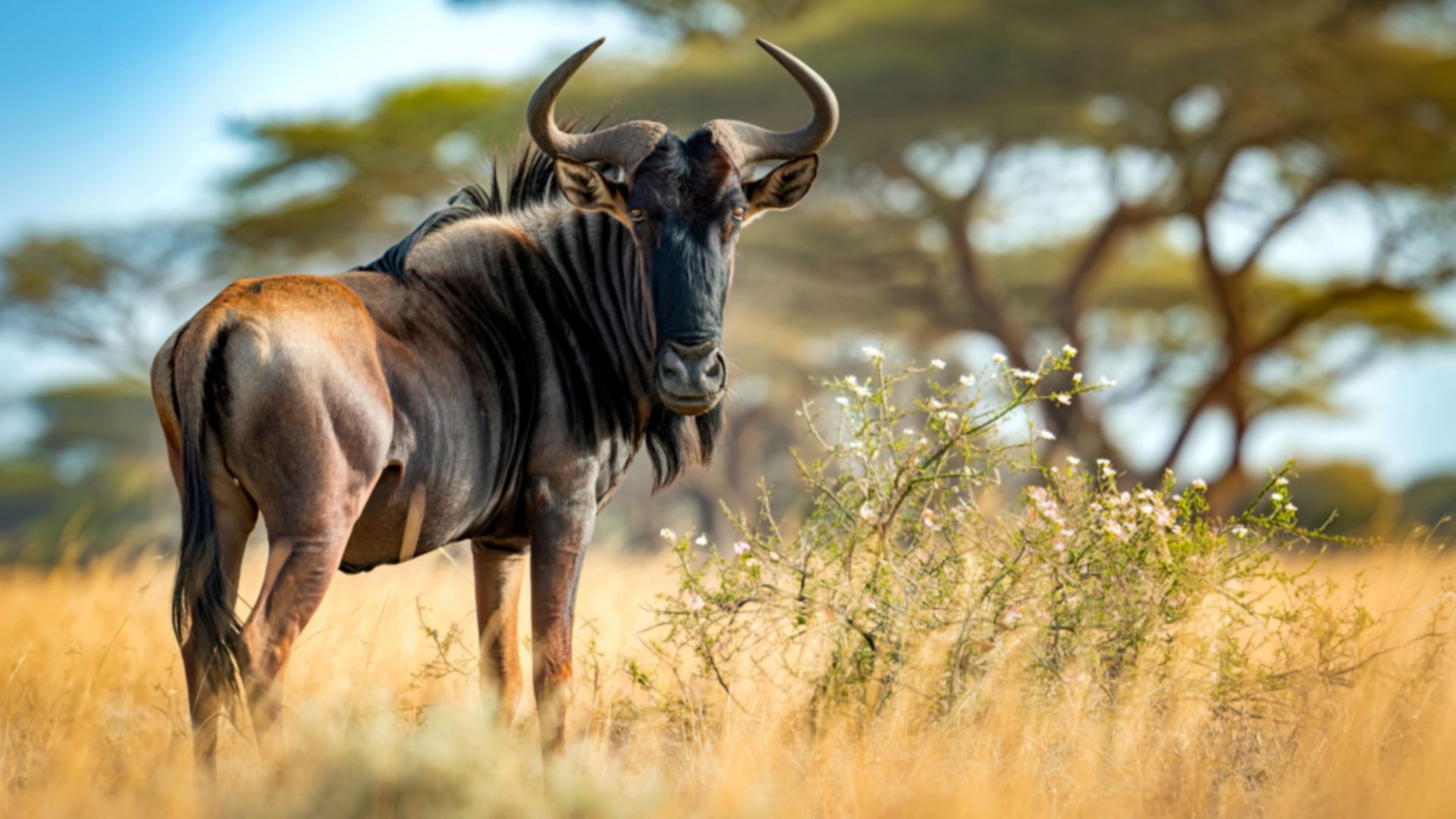
Every year, millions of wildebeest thunder across the Serengeti in one of the most spectacular wildlife migrations on Earth. Tourists travel from every corner of the globe to witness lions stalk zebras across golden plains, or crocodiles launch from rivers in a blur of teeth and muscle. Nobody comes to watch the dung beetles. And yet, without them, none of it would exist.
Few creatures better illustrate the dung beetle’s role in the Serengeti ecosystem than the beetle itself. Ecologists have called these insects the true engineers of the savannah, not the elephants, not the wildebeest, and not even the grass itself. This is the story of a creature that keeps one of the most biodiverse places on the planet alive, one ball of dung at a time.
The Serengeti’s Most Overlooked Wildlife: 100+ Dung Beetle Species

Most people assume the Serengeti’s ecological complexity rests with its megafauna: the lions, leopards, and buffalo of safari brochures. But beneath the drama of the food chain lies a workforce of extraordinary scale. More than 100 species of dung beetles have been recorded in Serengeti National Park alone, each one occupying a distinct ecological niche and contributing to the health of the ecosystem in a different way.
Different beetle species process different types of dung, operate at different times of day, and bury waste at different soil depths. The result is a layered, highly efficient biological recycling system that no single species, and certainly no human technology, could replicate. Their communities are shaped by soil type, vegetation cover, mammal diversity, and seasonal rainfall patterns, making them extraordinarily sensitive environmental actors.
Rollers, Tunnelers, and Dwellers: Three Strategies in the Serengeti Ecosystem
The dung beetle role in the Serengeti ecosystem plays out across three distinct behavioral guilds, each with a radically different approach to the same raw material.
Rollers (Telecoprids) are the ones most people recognize; they are the beetles that sculpt dung into a near-perfect sphere and push it backwards across the ground, sometimes for up to 100 yards. They are racing against competing beetles to secure their prize, rolling it to a safe distance before burying it as food and as a brood chamber for their larvae.

Tunnelers (Paracoprids) take a more direct approach, digging shafts directly beneath a dung pile and packing nutrients deep into the soil profile. Some species display remarkable sexual dimorphism: males develop large, curved horns to fight at tunnel entrances, while smaller males use stealth to sneak past dominant rivals.
Dwellers (Endocoprids) are the most sedentary, simply living and breeding within the dung pat itself. Though less dramatic, they play a critical role in breaking down the structural integrity of surface dung, making it accessible to bacteria, fungi, and other beetle types.
Together, these three guilds ensure that no dung resource goes to waste, and in the Serengeti, that resource is produced in almost incomprehensible quantities.
Serengeti Soil Is Literally Made of Buried Dung Balls
Here is a fact that stops most people cold: when soil researchers dug pits across the Serengeti plains, they discovered that 15 to 20% of the soil was composed of buried dung balls. Nearly one-fifth of the ground beneath your feet in one of Africa’s most celebrated wilderness areas is the legacy of dung beetle labor.
The scale is staggering. Dung beetles remove and bury up to 75% of all dung dropped in the Serengeti, amounting to several hundred tons per day. That buried organic matter decomposes underground, releasing nitrogen, phosphorus, potassium, and carbon directly into the soil; these nutrients feed the grasses, the grazers, and the predators.
Research conducted over a 112-day period found that the presence of large-bodied dung beetles enriched soil macronutrients by an average of 44.51% compared to control plots with no beetles. Without this constant underground fertilization, the Serengeti’s legendary grass productivity, the very foundation of its food web, would be impossible to sustain.
The Dung Beetle–Wildebeest Migration: An Unsung Ecological Partnership

The annual wildebeest migration, involving roughly 1.5 million animals, is often described as the greatest wildlife spectacle on Earth. Less discussed is the ecological partnership that makes it sustainable year after year.
As the herds move, dung beetles move with them, literally following the migration route, burying dung as they go. This isn’t incidental. The beetles bury not just waste but also undigested seeds that pass through the grazers’ digestive systems. When those seeds are buried in nutrient-rich dung underground, they germinate in ideal conditions. The result: the grasses the wildebeest depend on are literally replanted along the same routes the herds travel, year after year, season after season.
This feedback loop is one of the most elegant and least-known examples of mutualism in African ecology. The wildebeest sustain the beetles; the beetles sustain the grass; the grass sustains the wildebeest.
Stellar Navigation: The Dung Beetle That Steers by the Milky Way
If the ecological importance of the role of the dung beetle in the Serengeti ecosystem doesn’t impress you, consider this: the dung beetle is the first animal ever documented to navigate using the Milky Way.
Researchers at Lund University in Sweden discovered the phenomenon almost by accident. While studying how beetles use the polarized light of the moon to roll in straight lines, they noticed that on completely moonless nights, the beetles still navigated perfectly. They placed the beetles inside a planetarium and methodically turned off star groups. The beetles’ paths only became erratic when the Milky Way itself was obscured.
The beetles weren’t tracking individual stars; their eyes lack the resolution for that. Instead, they use the Milky Way’s broad luminous band as a compass bearing, maintaining a straight-line trajectory away from the dung pile and away from competing beetles who might steal their hard-won ball. Scientists have since used this insect navigation system as inspiration for AI-based low-light sensors in autonomous vehicles.
A creature that was rolling dung millions of years before humans looked up at the stars had already figured out how to use the galaxy as a GPS.
Disease Control, Greenhouse Gases, and Parasite Suppression
The dung beetle’s role in Serengeti ecosystem health extends far beyond soil fertility. Every dung pat left on the surface is a breeding ground for flies, parasitic worms, and disease-carrying organisms. By removing dung from the surface rapidly (some pats are fully buried within hours of being deposited), dung beetles dramatically reduce the disease burden across the Serengeti’s animal populations.

There is also a climate dimension that is rarely discussed. When dung decomposes naturally on the surface, it does so anaerobically, producing methane, a potent greenhouse gas. When dung beetles bury waste underground, they shift decomposition from anaerobic to aerobic, significantly reducing methane emissions from the ecosystem. In a world increasingly focused on carbon cycles and climate regulation, the dung beetle’s contribution to atmospheric chemistry deserves far more attention than it receives.
Their burrowing also aerates compacted soils, creating channels that allow rainfall to penetrate rather than run off, reducing erosion and improving water retention across the plains.
Dung Beetle Populations Are Under Threat — and So Is the Serengeti
Given everything these insects do, the threats they face should concern every person who cares about wild Africa. Climate change is altering rainfall patterns across East Africa, disrupting the timing of the wildebeest migration and, with it, the availability of dung at the times and places beetles need it most.
Agricultural expansion on the Serengeti’s borders introduces livestock treated with veterinary antiparasitic drugs, including ivermectin, whose residues persist in dung and are lethal to dung beetle larvae. Chemical pesticides used in surrounding farmland further reduce beetle populations in buffer zones that are critical for genetic diversity across the ecosystem.
Dung beetles are increasingly used by ecologists as indicator species. Their population diversity and density serve as a reliable proxy for overall ecosystem health. Where dung beetle populations decline, biodiversity loss typically follows. Their disappearance from a landscape is not just a symptom of ecological damage; it is a cause of further collapse.
Why the Serengeti Ecosystem Dung Beetle Role Matters to All of Us

The dung beetle is not charismatic. It does not appear on conservation posters or inspire safari packages. But the Serengeti ecosystem dung beetle role is a master class in the invisible architecture of nature; in how the most glamorous ecosystems on Earth are quietly sustained by the most unglamorous actors.
Every breath of clean air over the Serengeti plains, every blade of grass that feeds a wildebeest, every kill that sustains a lion pride, all of it rests, in part, on the labor of an insect that navigates by starlight, rolls balls of dung across the African night, and asks for nothing in return. The next time you think about what makes the Serengeti irreplaceable, remember: it is not just the lions. It is also the beetle beneath your boots.
Sources:
Stanbrook, Roisin, Edwin Harris, Martin Jones, and Charles Philip Wheater. “The Effect of Dung Beetle Size on Soil Nutrient Mobilization in an Afrotropical Forest.” Insects, vol. 12, no. 2, National Center for Biotechnology Information / U.S. National Library of Medicine, 7 Feb. 2021.
Dacke, Marie, Emily Baird, Marcus Byrne, Clarke H. Scholtz, and Eric J. Warrant. “Dung Beetles Use the Milky Way for Orientation.” Current Biology, vol. 23, no. 4, Cell Press / ScienceDirect, 18 Feb. 2013.
Andresen, Ellen, and Ana Lucía Morales-Pérez. “Seed Size and Pubescence Facilitate Secondary Dispersal by Dung Beetles.” Biotropica, Wiley Online Library, 5 Dec. 2021.
Venter, Zander, Shaun Dicks, and Marcus J. Byrne. “Experimental Study on the Effect of Ivermectin on Cattle Dung Faunas and Dung Removal.” PLOS ONE, Public Library of Science, 15 Apr. 2025.
Leave a Reply